Why I Keep a Skeleton in My Office 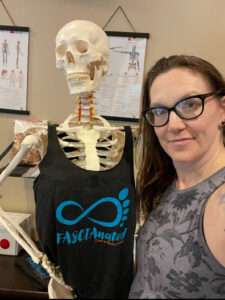
This is about to get graphic… but not too graphic. 🙂
Someone came into my office recently and was “put off” to see my skeleton. I use this skeleton to teach both my students and my clients. Besides the hot pillows and self-massage balls, it’s one of the most important tools I use to educate.
I also find it super nerdy and fascinating to think that we carry around these organs and bones with us — and we’ll never actually see our own… unless you’re in the story below.
A Story About Preserving Bones
I saw an article about a woman who preserved her husband’s lower leg bone after a vehicle accident that required an amputation. She took it to a museum that specializes in preservation. They mounted it, and she received it back to keep in her home. You can even see where the accident took place. Creepy — and very cool.
A friend of mine recently posted about her parents going through aquamation, where the only remains were the bones. The only remains were the bones.
It made me think about how important our bones are — not only as part of our legacy once we’re gone but also for our function while we’re alive.
Bones as Legacy — and Life
As I type this, I keep thinking of all the reasons our bones matter so much. I think about how I grew four sets of bones in my own body — bones that will continue on long after my living days.
Much of my reading and inspiration comes from Sophie Strand and Perdita Finn, and their concepts of returning to compost — how it is a gift to return our bodies to where they came from: the earth.
“Make Me Good Soil” is the name of Sophie’s Substack, and I look forward to every new post. Perdita, in a recent course I took with her, spoke about using the term “root ball” instead of “lineage.” It might bother some people, but I see the sense in it.
More Than Muscles: What Massage Really Touches
Most people think massage therapists are “rubbing muscles,” which is only part of what we do. The longer I do this work, the further away from muscles I find myself.
Bones.
I’m often tracking bones — where they connect and how they’re being moved (by which muscles). I’m also observing nervous system responses and tracking patterns. Bones don’t get nearly enough respect.
Many people associate chiropractors with bones and massage therapists with muscles, but I think we’re all working together — just from different perspectives. Muscles hold bones, and bones hold muscles. (That’s super simplified, of course.) And that’s only where it begins.
The Questions That Guide My Work
Some of the questions I find myself asking during sessions:
-
What is shaping the consistency of these tissues?
-
How can a person move through their range of motion?
-
Where is the hang-up — and how far does it go?
And many, many more.
We All Carry a Skeleton
Don’t be afraid of my Skelly. You have one right inside your skin as you read these words.
Your bones are here to help you connect — and reach out to the world around you.